Point-in-time data foundation
Licensed market, reference, fundamental and alternative data are versioned with corporate actions, lineage and quality controls.


QuantTradeMaster
QuantTradeMaster separates market data, research, portfolio construction, execution and post-trade evidence so quantitative workflows remain reproducible, risk-aware and operationally resilient.
QuantTradeMaster separates system tiers and responsibilities according to asset class, frequency, market access, data rights, strategy capacity, risk and resilience requirements.
Licensed market, reference, fundamental and alternative data are versioned with corporate actions, lineage and quality controls.
Factor research and backtesting address look-ahead, survivorship, selection, leakage, multiple testing, capacity and cost.
Constraints, exposure, liquidity, stress, scenario and pre-trade controls connect research intent to executable orders.
OMS, EMS, routing, venue connectivity, TCA, reconciliation, audit and disaster recovery form the operating chain.
A research workbench, institutional portfolio platform, electronic execution system, low-latency stack and multi-asset platform are not interchangeable.
Versioned local or cloud research with basic entitlement and reproducibility controls.
Point-in-time data, distributed research, independent validation, mandate controls and audit.
OMS/EMS, market connectivity, pre-trade risk, records, monitoring and business continuity.
Co-location, direct feeds, deterministic paths, hardware time, capacity tests and venue-specific controls.
Legal-entity, product, protocol, time-zone, entitlement, reconciliation and resilience boundaries.
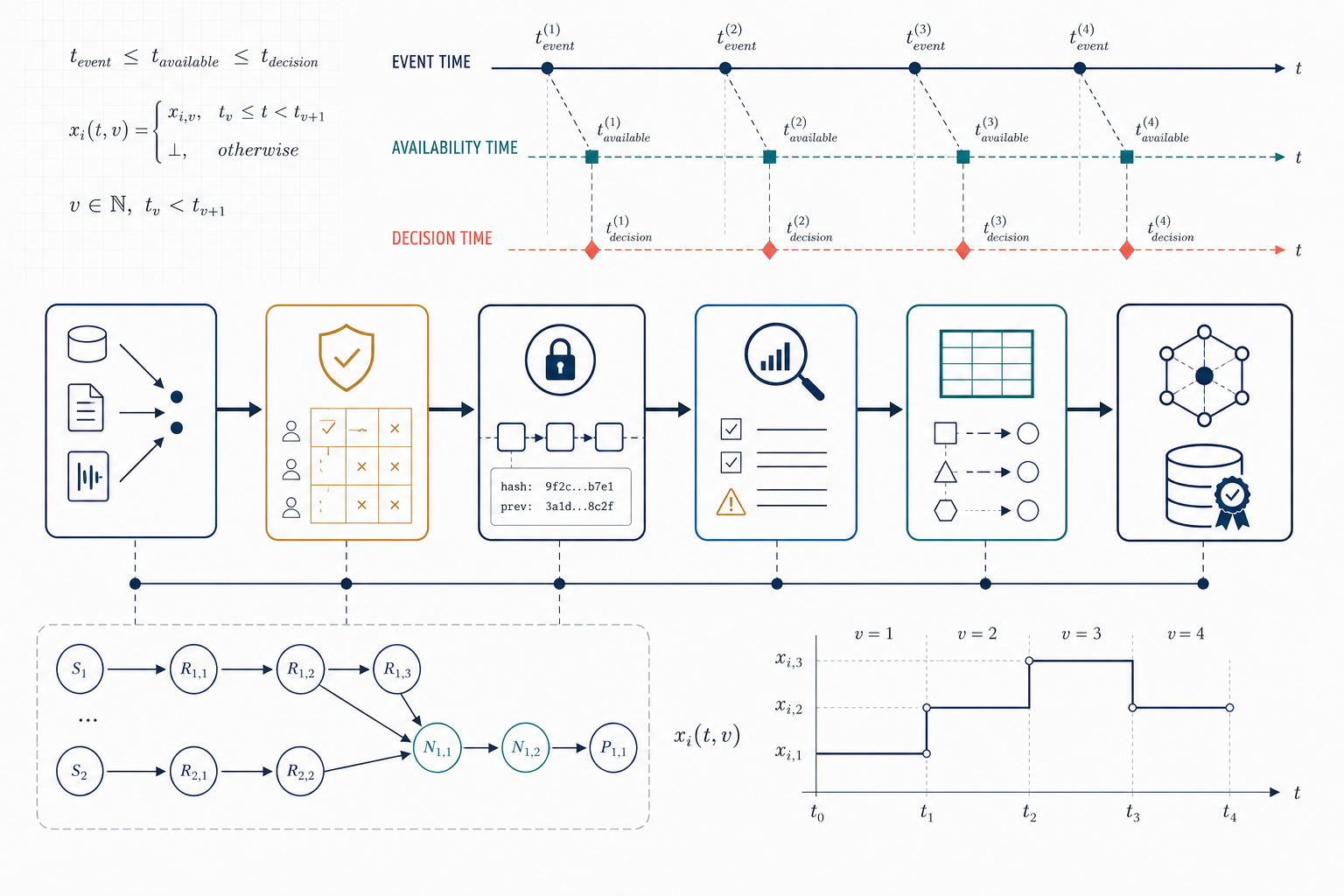
Licensed market, reference, fundamental and alternative data are governed by purpose, user, application, location and redistribution rights.
Event time, publication time, availability time, revisions, raw capture and lineage preserve what was knowable at each decision point.
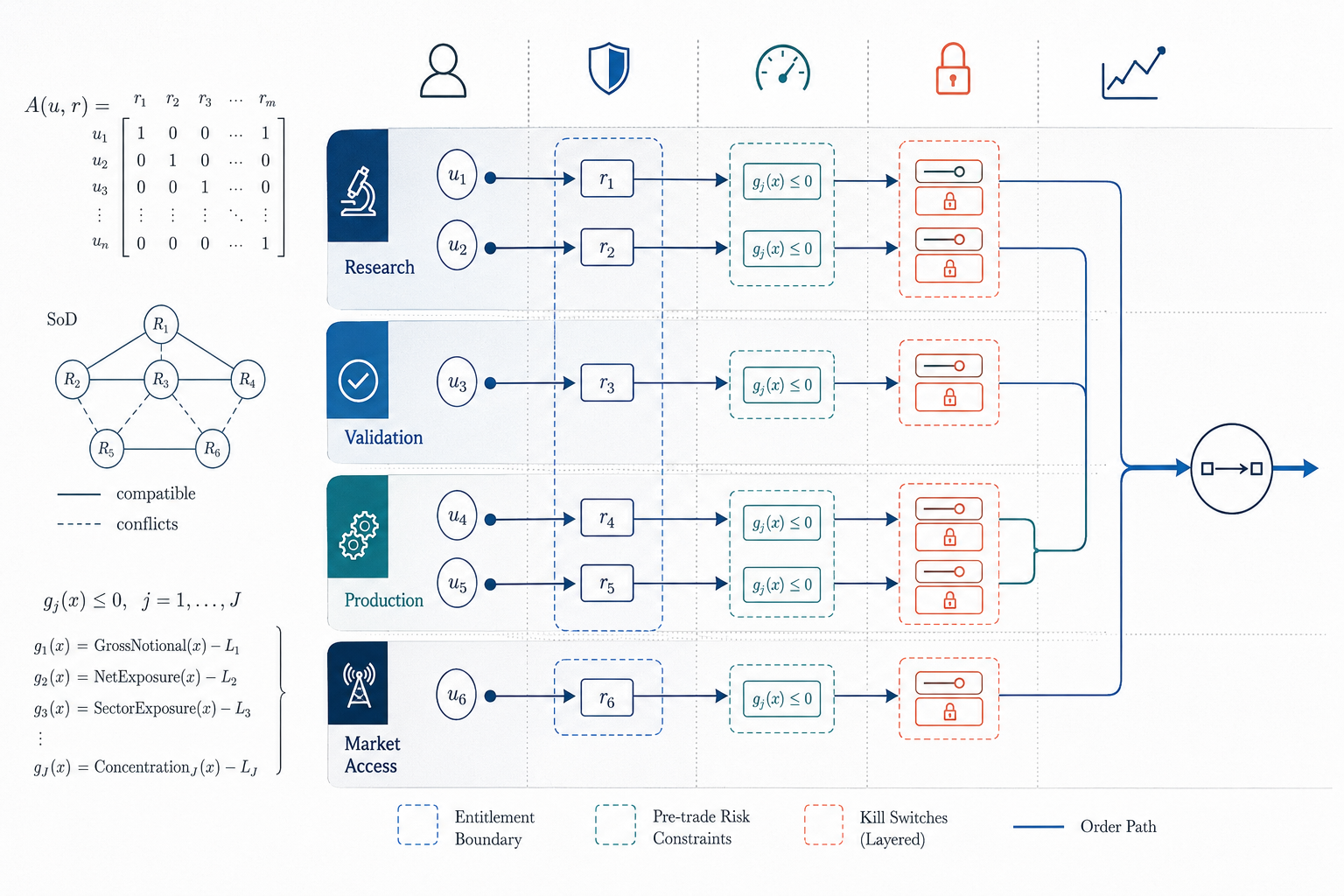
Human and service identities operate through least privilege, segregation of duties and explicit boundaries across research, validation, production and market access.
Price, size, notional, position, credit, concentration, restricted-instrument and message-rate constraints run outside the strategy process with layered kill switches.
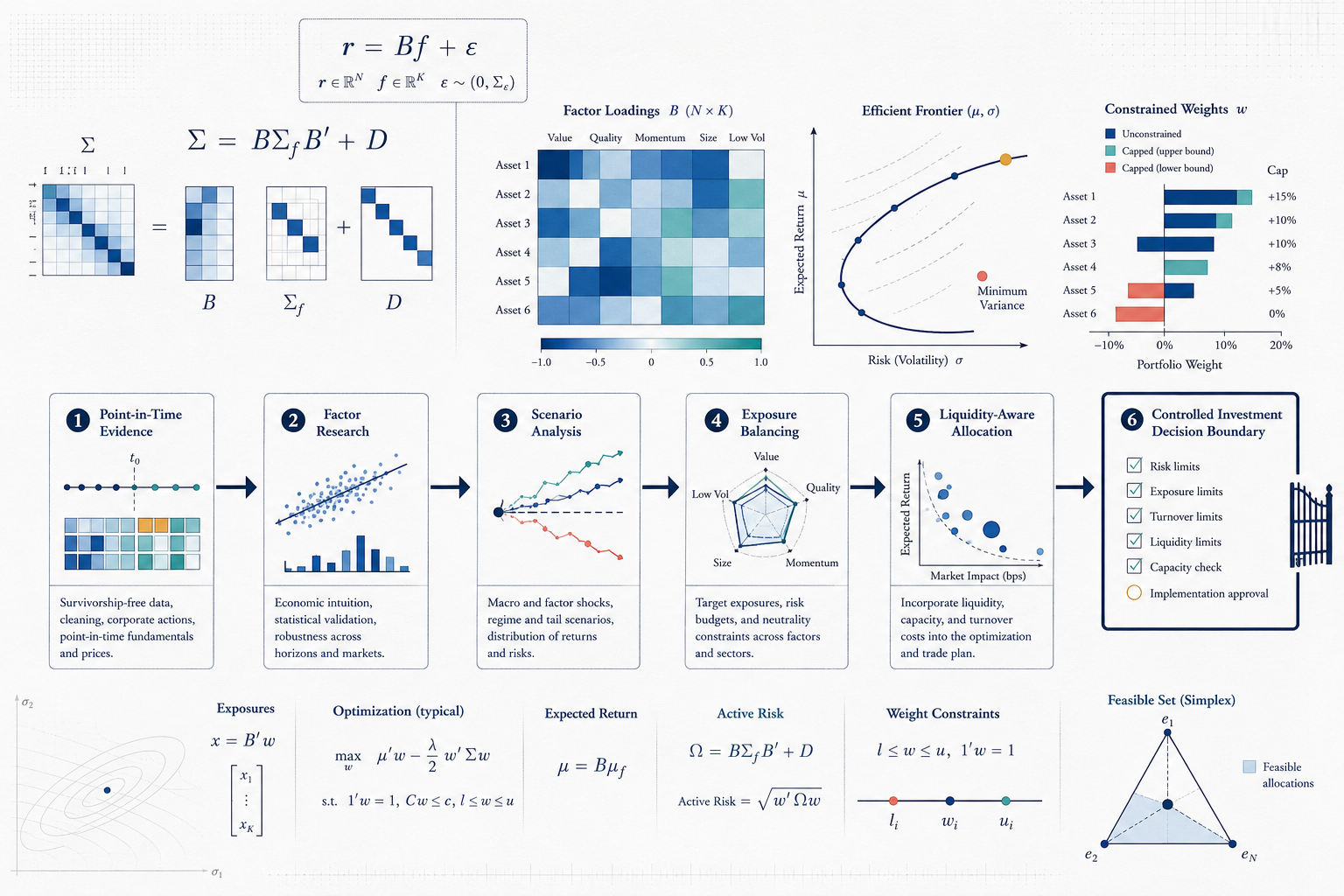
Point-in-time evidence, factor models, scenario analysis and independent validation connect economic hypotheses to reproducible research.
Factor exposure, covariance, concentration, liquidity, capacity, turnover and mandate limits shape feasible allocations and controlled investment decisions.
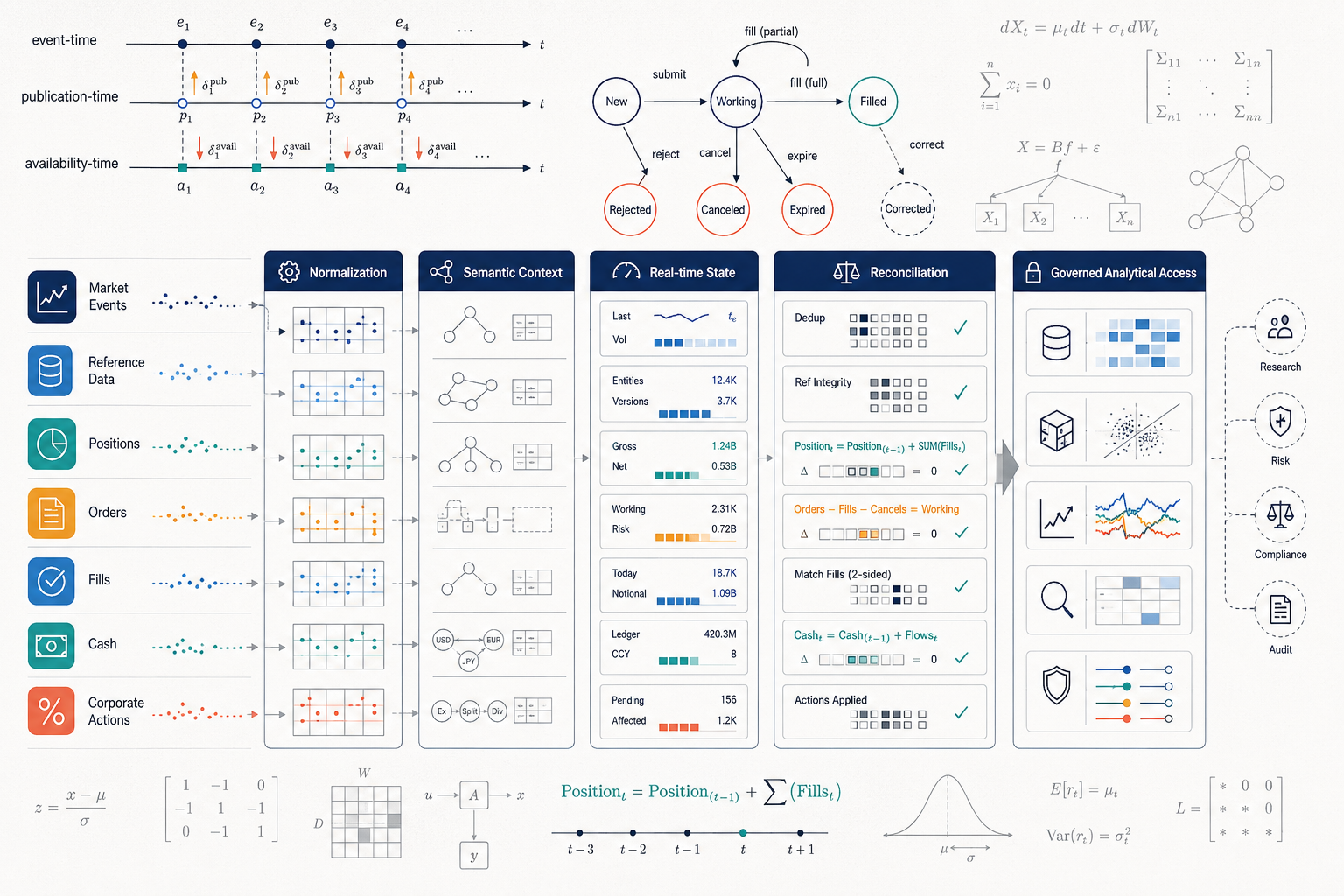
Market events, reference data, orders, fills, positions, cash and corporate actions share normalized semantics, lineage and real-time state.
OMS and EMS state, drop copy, allocations, reconciliation and transaction-cost analysis preserve a consistent record from decision through settlement.
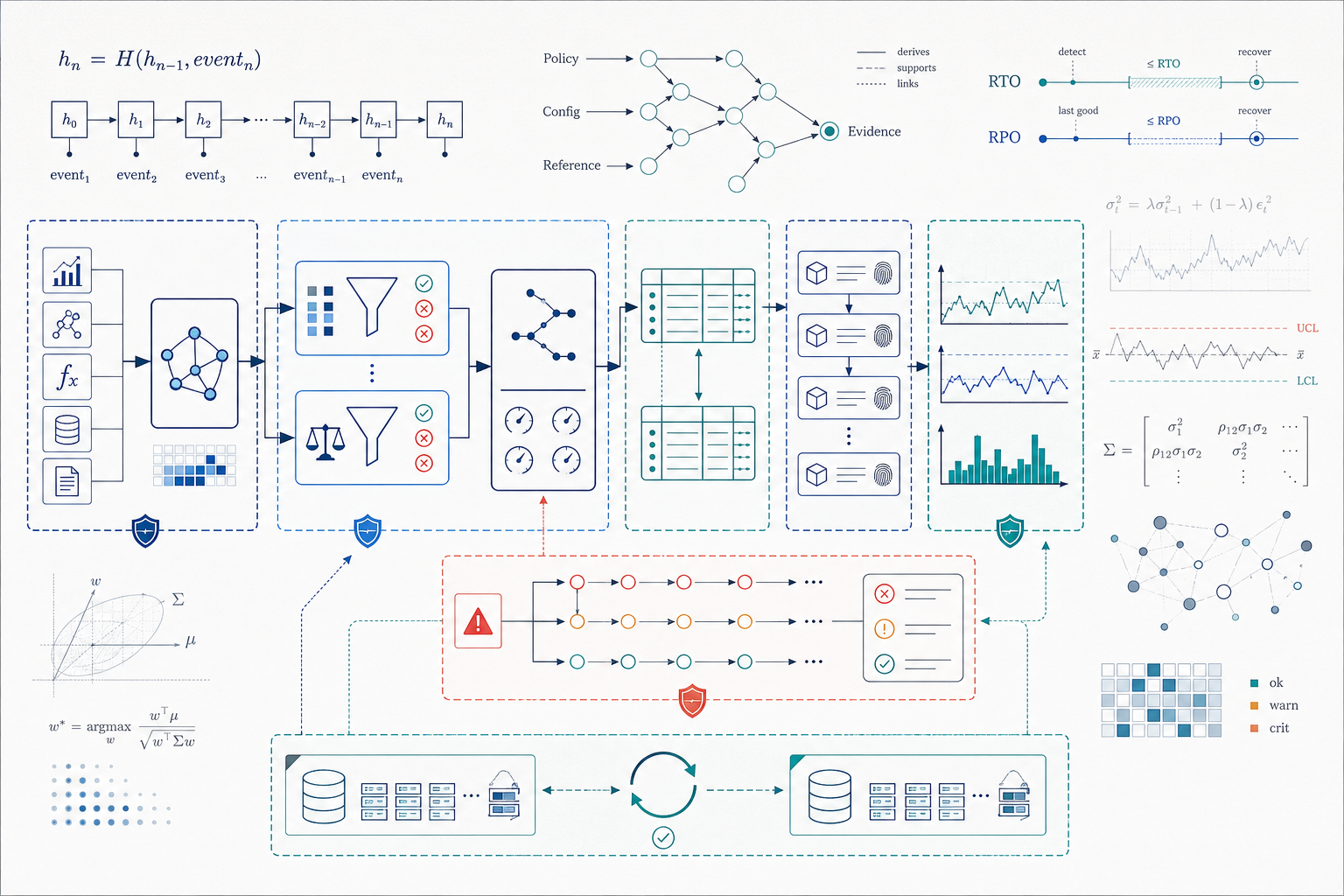
Mandate, restricted-list, approval and recordkeeping controls produce append-only evidence that links policy, configuration, decisions and operator actions.
Observability, incident response, safe shutdown, high availability, recovery objectives and rehearsed disaster scenarios protect continuity and accountability.
Point-in-time integrity, dependence, model selection, realistic costs, capacity and staged release determine whether research is fit to progress.
Use the universe, fundamentals, corporate actions and source revisions actually available at each decision time.
Purged cross-validation and embargo isolate overlapping labels, serial dependence and information leakage.
Deflated Sharpe Ratio, Probability of Backtest Overfitting and full experiment records control selection bias.
Spread, fees, slippage, market impact, borrow, turnover and participation limits convert theoretical signals into executable economics.
Rolling and walk-forward tests, subperiods, parameter stability, perturbation, stress and regime analysis expose fragile behavior.
Independent review, replay, simulation, paper or shadow operation, canary limits and production approval separate research from live capital.
The execution chain handles market state, order state, independent controls, timing, reconciliation and failure as first-class production concerns.
Schema validation, sequence and gap recovery, raw capture, normalized events and in-memory books preserve market state.
New, acknowledged, partially filled, cancelled, rejected, disconnected and recovered states remain deterministic and replayable.
Order lifecycle and compliance remain separate from execution algorithms, venue selection and routing tactics.
Fat-finger, price, size, notional, position, credit, duplicate, restricted-list and message-rate controls block before release.
Strategy, account, user, venue, session and global controls are independent, tested and fully audited.
Fills, drop copy, positions, P&L, limits and stale-state detection are continuously reconciled.
In-memory and lock-free processing, co-location, kernel bypass, DPDK/RDMA, SmartNIC or FPGA are selected only where workload value justifies complexity.
Venue, feed, database, time-service, cloud-region and site failures are rehearsed with order and position recovery evidence.
Independent validation and controls separate exploratory research from production capital and market access.
Licensed data, schema, sequence, clock and immutable raw evidence.
Point-in-time data, factors, models and reproducible experiments.
Out-of-sample, bias, cost, capacity, stress and approval.
Portfolio, risk, OMS/EMS, pre-trade controls and kill switches.
Venues, TCA, reconciliation, audit, continuity and review.
Order protocols, low-latency sessions, venue interfaces, payments, derivatives and clock synchronization serve different responsibilities.
Cross-asset order, execution and post-trade messages
High-performance session semantics and binary encoding
Venue-native market data and order entry
Payments, securities and post-trade messaging
OTC derivatives products and lifecycle events
Clock synchronization and event ordering
Market-specific obligations, model governance, operational reliability and performance evidence are integrated into delivery.
SFC/HKEX, MiFID II/RTS 6, DORA, SEC/FINRA and MAS/SGX controls are applied according to legal entity, activity and market access.
Purpose, data, limitations, independent validation, approval, artifact identity, deployment, monitoring and retirement are recorded.
Capacity, abnormal messages, disconnects, partial fills, cancel rejects, market halts, recovery and disaster scenarios are rehearsed.
Research integrity, net-of-cost behavior, exposure, capacity, execution quality, latency distribution, reconciliation and resilience are evaluated together.
Machine learning supports research, execution and risk where timing, rights, non-stationarity, capacity and simulation-to-live differences are controlled.
Regularized models, gradient boosting and neural representations support nonlinear multi-source features with decay and crowding controls.
State-space, boosting, sequence models and ensembles support signals and risk, with non-stationarity and structural breaks explicitly tested.
Order-book and queue features support short-horizon forecasting and execution where latency, market response and capacity permit.
Impact models, control methods, bandits and constrained reinforcement learning optimize schedules, venues and participation without unbounded exploration.
Licensed filings, news and transcripts support extraction, retrieval and research workflows; LLMs do not become autonomous price-prediction engines.
Rights, timestamp integrity, sample bias, entity mapping and signal decay govern image, sensor, location and web-derived inputs.
Controls are mapped by jurisdiction and operating role instead of being presented as one universal certification.
SFC electronic and algorithmic trading controls, HKEX market safeguards, records, testing and market-data rights are applied to the relevant licensed activity.
SEC market-access controls, FINRA algorithmic strategy supervision and applicable system obligations are mapped to broker-dealer and activity scope.
MiFID II Article 17, RTS 6, venue controls, DORA and FCA requirements inform resilient systems, limits, testing, records and ICT risk.
MAS technology-risk and continuity requirements plus SGX direct-market-access controls are applied according to institution and market participation.
Identity, separation of duties, provenance, network boundaries, immutable evidence and rehearsed incident response span the platform.
Federated identity, MFA, service identities, least privilege, just-in-time access, vaults, HSMs and rotation protect market access.
Research, validation, release, risk and operations retain independent authority and production access.
Protected branches, review, reproducible builds, signatures, SBOM, dependency controls and immutable releases protect provenance.
Research, validation, production, market-access and management planes are isolated by identity, network and data policy.
Orders, decisions, market data, configuration, code, model versions and operator actions use time-consistent append-only records.
Venue contacts, cancel procedures, position reconciliation, forensic capture, safe shutdown and recovery are maintained as tested playbooks.
Data, research, portfolio, execution, systems, security and business evidence are evaluated together.
Entitlement, point-in-time accuracy, completeness, sequence, clock, revision, lineage and cost.
Out-of-sample behavior, multiple-testing control, stability, reproducibility and economic rationale.
Exposure, concentration, turnover, liquidity, borrow, capacity, stress and mandate constraints.
Implementation shortfall, fill, rejection, spread, impact, venue quality and latency distribution.
Availability, jitter, message loss, recovery, RTO/RPO, capacity and change-failure rate.
Access, approval, artifact identity, audit, model validation, vendor risk and incident evidence.
Net-of-cost outcome, drawdown, capital efficiency and mandate fit, with no implication that historical performance predicts future results.